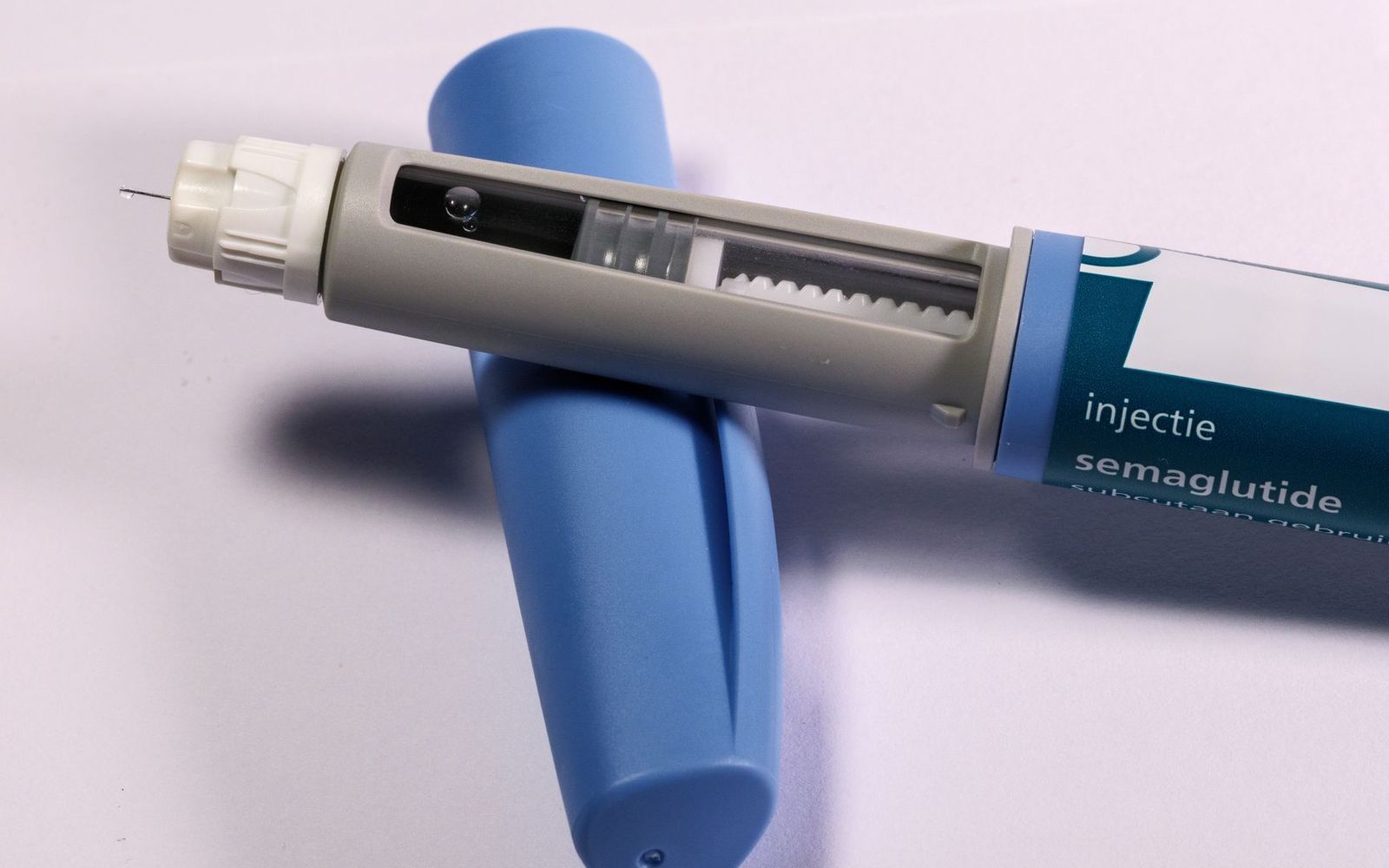
The two scans, side by side
Each drug's main obesity trial ran a body-composition substudy. A subset of participants had a whole-body DXA scan (dual-energy X-ray absorptiometry, which separates fat, bone mineral and lean soft tissue) at the start and at the end. Neither trial enrolled people with diabetes, and each was funded by the drug's maker: Novo Nordisk for STEP 1, Eli Lilly for SURMOUNT-1 and its substudy. In SURMOUNT-1 the lifestyle advice was a 500-calorie daily deficit and at least 150 minutes of activity a week "without a specific strength training protocol"; the STEP 1 abstract describes its lifestyle intervention by name only.
| STEP 1: semaglutide 2.4 mg (Wegovy) | SURMOUNT-1: tirzepatide 5, 10 or 15 mg pooled (Zepbound) | |
|---|---|---|
| Scanned at start and end | 140 (95 drug, 45 placebo), BMI 40 or under, 9 sites | 160 (124 drug, 36 placebo), 28 sites |
| Time on treatment | 68 weeks | 72 weeks |
| Body weight | -15.0% | -21.3% |
| Fat mass | -19.3% | -33.9% (-15.9 kg) |
| Lean mass | -9.7% | -10.9% (-5.6 kg) |
| Share of weight lost that was lean mass | About 38% (see below) | 26% |
| Placebo group | "No major changes in body composition" | Weight -5.3%, fat -8.2%, lean -2.6%; 25% of the loss was lean |
The STEP 1 abstract gives percentage changes, not the split. Applied to the starting composition it reports for the semaglutide group (lean mass 53.9 percent of body weight, fat 43.4 percent), lean loss comes to about 5.2 percent of starting weight and fat loss to about 8.4 percent, so lean mass is about 38 percent of what was lost (our arithmetic). The joint advisory reports the same split: of an average 13.6 kg lost, 8.3 kg (62 percent) was fat and 5.3 kg (38 percent) was lean mass. The SURMOUNT-1 substudy authors, citing STEP 1's supplementary data, give 10.4 kg of fat and 6.9 kg of lean, a 60 to 40 split. The journal's site would not let us open that supplement, so we cannot reconcile the two figures, and neither pair squares with the abstract: 15.0 percent of 98.4 kg, the mean starting weight of everyone scanned, is about 14.8 kg (our arithmetic), more than the advisory's 13.6 kg and less than the 17.3 kg the substudy authors' figures add up to. Both put lean mass at close to two fifths of the loss.
The STEP 1 abstract also reports the number the lean-loss figure hides. Fat fell faster than lean tissue, so lean mass as a share of body weight rose by 3.0 percentage points, and the lean-to-fat ratio improved more in people who lost 15 percent or more of their weight than in those who lost less.
Why the two drugs cannot be ranked from this table
Reading 26 percent against 38 percent as Zepbound sparing muscle is the obvious move, and the evidence does not support it. These are separate trials with different sites, scanners, durations and participants, so a gap between them is not a comparison of the drugs. The more telling number is inside SURMOUNT-1: its placebo group, losing far less weight on lifestyle advice alone, lost almost the same share as lean mass, 25 percent against 26. In this trial the drug did not change the split. The substudy authors conclude that tirzepatide "does not induce disproportionate lean mass loss". That is a statement about proportion. In absolute terms the drug group lost more lean mass, 5.6 kg against 1.2 kg on placebo, because it lost more weight.
By age group, the share of weight lost as fat on tirzepatide was 74 percent under 50, 75 percent at 50 to 64 and 76 percent at 65 and over. Those are post hoc subgroups, and the authors warn that they were small.
Lean mass is not muscle
SURMOUNT-1's paper defines lean mass as total fat-free mass minus bone mineral content, "also known as lean soft tissue mass". Fat-free mass, in the words of a 2024 Pennington Biomedical paper, "includes the body's main functional tissues and organs", skeletal muscle among them. It also carries water. Glycogen and protein are both stored with water, and a 2014 review by the same lead author explains that their early losses on a calorie deficit are mirrored in the fat-free mass number. Some of what a scan calls lean loss is that water.
The joint advisory from the American College of Lifestyle Medicine, the American Society for Nutrition, the Obesity Medicine Association and The Obesity Society states that "muscle mass is about half of lean body mass", and on that basis estimates that about 20 percent of the weight lost in STEP 1 was muscle. The same approximation applied to SURMOUNT-1's 26 percent would give about 13 percent (our arithmetic, using the advisory's rule of thumb, not a measurement).
One tirzepatide study measured muscle directly with MRI, in a different population. SURPASS-3 MRI followed 246 adults with type 2 diabetes for 52 weeks on tirzepatide or insulin degludec, in a post hoc analysis funded by Eli Lilly. In the abstract, which is what we read, thigh muscle volume fell by 0.64 liters on tirzepatide, a change the authors found in line with what UK Biobank data predict for that much weight loss, while fat stored inside the muscle fell by more than predicted. At the 15 mg dose, a size-adjusted muscle volume score fell by more than the population estimate.
How this compares with dieting
The joint advisory says the fat, lean and muscle losses seen with GLP-1s "correlate with the degree of body weight reduction and are similar to those documented with other obesity therapies that achieve large weight reductions, such as bariatric surgery and very low-calorie restricted diets". The figure most often quoted is that about a quarter of diet-induced weight loss is fat-free mass. Heymsfield and colleagues traced that "Quarter FFM Rule" in 2014 and examined how it shifts over time and with aging, inactivity and exercise, noting that lean losses with dieting tend to be small, which raises questions about study design, statistical power and how reliably the methods measure them.
A 2024 study led by the same author built prediction models from whole-body MRI measurements of skeletal muscle in 897 adults who were not exercising, then checked them against two calorie-restriction studies of 74 and 26 people. In nonelderly adults with overweight or obesity cutting calories without a structured exercise program, the authors estimate muscle losses of about 2 to 2.5 kg per 10 kg of weight lost in men and 1 to 1.5 kg in women. The joint advisory cites this work for its estimate that, without structured strength training, muscle makes up 10 to 15 percent of weight lost in women and 20 to 25 percent in men.
Sponsored option
Vetted Aug 19, 2026Affiliate link, we may earn a commission at no extra cost to you.

Sesame Our score 4.0/5
Telehealth / primary care
Pricing as of Aug 19, 2026
Telehealth visits from $34; weight-loss program $99/mo or $59/mo annual
What protects muscle, and how strong the evidence is
The joint advisory's position is that GLP-1s "should be prescribed together with a structured exercise program, aiming for regular strength training at least 3 times weekly plus at least 150 min of moderate-intensity aerobic exercise weekly". On protein it gives the adult recommended allowance of 0.8 g per kilogram of body weight a day, notes that 1.2 to 1.6 g/kg has been proposed during active weight reduction, and suggests an absolute target of 80 to 120 g a day as easier to follow. It says intake should not fall below 0.4 to 0.5 g/kg, and that prolonged intake at or above 2 g/kg should be avoided.
That advice rests mostly on diet and exercise research, not on trials of these two drugs. A PubMed search we ran on October 28, 2026 found a published protocol for a randomized trial of resistance exercise and protein during semaglutide or tirzepatide treatment (LEAN-PREP, 232 adults planned, results not yet reported) and one tirzepatide-and-exercise trial that has since been retracted. It found no completed randomized trial of either drug plus strength training that reports lean mass.
The closest randomized evidence uses liraglutide, an older daily GLP-1. 195 adults without diabetes, who had lost an average of 13.1 kg on an 8-week low-calorie diet, were randomly assigned to a year of a moderate-to-vigorous exercise program, liraglutide, both, or placebo. In the abstract, the combination decreased body-fat percentage by 3.9 percentage points, "approximately twice" the decrease with exercise alone or liraglutide alone (Lundgren et al., New England Journal of Medicine 2021). The exercise was not a strength program, and the outcome was body-fat percentage, not muscle.
Protein without training has a weaker record than most people assume. Our guide to protein after 40 walks through the trials in which extra protein alone did not add lean mass, and our guide to creatine after 50 covers why creatine adds modestly to strength gains only alongside resistance training.
What to do next
If you are starting Wegovy or Zepbound, or are already on one, the lever the evidence supports is training, with protein as the supporting act. Our guide to muscle after 40 and strength training sets out the training floor and a simple strength test you can repeat while the weight comes off. Nausea and early fullness can push protein intake down, so read what the GLP-1 labels report about side effects and raise intake problems with your prescriber. The joint advisory describes bioelectrical impedance as a pragmatic, low-cost way for a clinic to track muscle mass if your weight is falling fast. If you are weighing whether to stop, what happens when you stop covers the trials that measured it. For the screenings that fit your age and sex, build your personal screening plan.
Frequently asked questions
Does Wegovy cause muscle loss?
Weight loss on Wegovy includes some lean tissue, as any large weight loss does. In STEP 1's scan substudy, lean mass fell 9.7 percent while fat fell 19.3 percent, so lean mass rose as a share of body weight. Muscle is part of that lean loss, about half of it on the joint advisory's estimate.
Does Zepbound cause less muscle loss than Wegovy?
The published scans cannot answer that. Lean mass was 26 percent of the weight lost on tirzepatide in SURMOUNT-1 and about 38 percent on semaglutide in STEP 1, but those were separate trials with different people and methods. In SURMOUNT-1 the placebo group lost almost the same share as lean mass, 25 percent against 26, so the drug did not change the split in that trial.
How much protein should I eat on a GLP-1?
The 2025 joint advisory notes the adult allowance of 0.8 g per kilogram a day, higher proposed targets of 1.2 to 1.6 g/kg during active weight loss, and an absolute target of 80 to 120 g a day as a practical option. It advises against falling below 0.4 to 0.5 g/kg or staying at or above 2 g/kg. Agree a figure with your clinician.
Do I need a body scan to know if I am losing muscle?
The joint advisory names several ways to monitor muscle mass and calls bioelectrical impedance pragmatic and low cost for repeated checks. A scan measures lean mass, which includes water and organs, so a strength test you repeat over time tells you something a scan does not.
Is lean mass loss on these drugs riskier after 65?
The SURMOUNT-1 substudy authors write that lean mass decrease "may be undesirable for older adults with or at risk of developing sarcopenic obesity". In their small post hoc subgroup aged 65 and over, 76 percent of the weight lost on tirzepatide was fat, similar to younger groups. The joint advisory names older age among the groups in which low protein intake may add to muscle loss.