Coverage and advice after 70, side by side
| What Medicare does | What the USPSTF says | |
|---|---|---|
| Screening PSA (code G0103) | Pays once 11 full months have passed since the month of the last one; no upper age; $0 for the test. Medicare pays the lab $19.31 | Recommends against routine screening at 70 and older (grade D, May 8, 2018) |
| Screening rectal exam (G0102) | Same frequency; you pay 20% after the deductible. National amount $24.38 in an office | Its statement is about PSA-based screening |
| PSA for symptoms or a known problem (84153) | Diagnostic test under NCD 190.31; usually $0 on Original Medicare. Medicare pays the lab $18.39 | Not screening; outside the recommendation |
How the 12-month count works
The regulation pays for a screening PSA for a man over 50 "only if the man has not had such an examination paid for by Medicare during the preceding 11 months following the month in which his last Medicare-covered screening prostate-specific antigen blood test was performed." CMS's claims manual gives the counting rule: start with the month after the last test, and the man is eligible again in the same month a year later. So a screening PSA on December 18, 2025, can be repeated from December 1, 2026 (our arithmetic), a few weeks short of a full year. Medicare.gov's version, "once every 12 months," is the same rule rounded.
The age wording is precise too. Payment "may not be made" for a man "age 50 or younger," which Medicare.gov translates as starting the day after your 50th birthday. Nothing in 42 CFR 410.39, NCD 210.1 or Medicare.gov's page stops coverage at 70, 75 or any other age.
When a PSA after 70 is not screening at all
Medicare's national rule for diagnostic PSA testing, NCD 190.31, covers the test for men with lower urinary tract signs or symptoms, which it lists as "hematuria, slow urine stream, hesitancy, urgency, frequency, nocturia and incontinence," for a prostate that feels abnormal on exam, for other lab or imaging findings that suggest cancer, and to follow prostate cancer once it is diagnosed. For symptoms, it says the test "is performed only once per year unless there is a change in the patient's medical condition."
Its October 2026 code list holds 51 diagnosis codes, and three matter most after 70: an elevated PSA (R97.20), a rising PSA after prostate cancer treatment (R97.21) and a personal history of prostate cancer (Z85.46). The first one means a recheck after a high screening result is a diagnostic test, so it does not wait out the 11 months. A family history of prostate cancer is not on the list; on its own, it keeps the test a screening test.
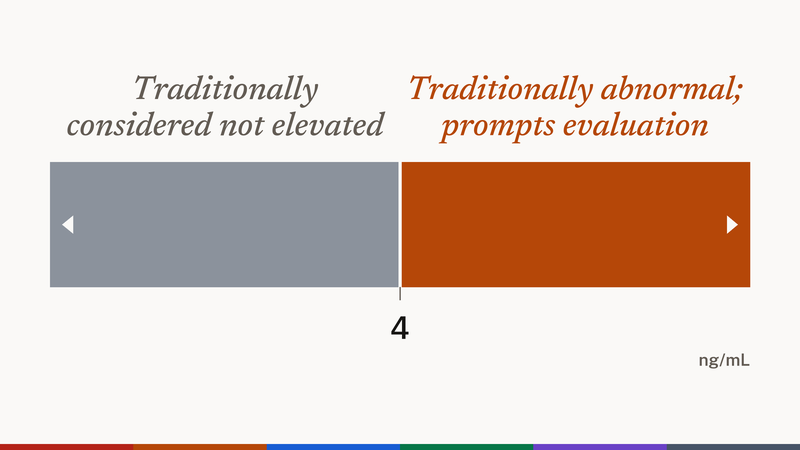
For what a high number means once you have it, see our guide to a PSA between 4 and 10 and free PSA percentage; normal PSA levels by age covers how the usual ranges shift for older men.
Why the advice changes at 70
The USPSTF's 2018 statement, still the current one on November 16, 2026 though its page shows an update in progress, grades screening a C for men 55 to 69 and a D at 70 and older: "The USPSTF recommends against PSA-based screening for prostate cancer in men 70 years and older." Its clinician summary says "Harms are greater for men 70 years and older" and that clinicians "should not routinely screen men 70 years and older." The harms it names are false positives that lead to more tests and biopsies, overdiagnosis and overtreatment, and treatment complications such as incontinence and erectile dysfunction.
Not every body agrees on a hard stop. Our prostate cancer screening page, which read the American Urological Association's 2026 amendment, reports that the AUA sets no fixed stopping age and leaves the interval, or stopping, to a shared decision based on preference, age, PSA history, risk, life expectancy and health.
Questions to settle with your clinician before the next one
- Is this test screening or diagnostic? If you have urinary symptoms or a past high result, say so; the reason on the order changes the rule that applies.
- What would we do with a high result? If the answer is nothing you would accept, such as a biopsy or treatment, the test may only add worry.
- What did my earlier PSAs show? Our screening page reports that the AUA counts PSA among the factors in deciding whether to stop.
- Do I need the rectal exam too? It carries the coinsurance; the PSA does not.
- Is my clinician accepting assignment? Medicare.gov says you may owe a fee for the clinician's services if not, though not for the test itself.
What it costs, and what triggers a bill
On Original Medicare, the screening PSA itself costs nothing. A rectal exam is billed separately: 20% of the Medicare-approved amount after the $283 Part B deductible, plus a separate copayment in a hospital outpatient setting. At the 2026 national office amount of $24.38, which is our arithmetic from CMS's relative value file before local adjustment, 20% is $4.88; if you have not met your deductible, you would owe the whole amount. A screening PSA billed before the month count is met is denied as too frequent; the lab can give you an Advance Beneficiary Notice before the draw, and our ABN guide explains your three choices.
Medicare Advantage: 42 CFR 422.100(k) bars cost sharing for in-network Medicare-covered preventive services, and 42 CFR 410.152(l)(4) defines those for the prostate as "Prostate cancer screening tests (excluding digital rectal examinations)." Paying cash instead? Our PSA price comparison lists three sellers.
NIDDK says to see a health care professional "right away if you are unable to urinate or have severe pain in your abdomen." New trouble passing urine or blood in the urine calls for a visit with a clinician, not a screening test.
What we checked and what we did not
We read 42 CFR 410.39 and 410.152 on eCFR, NCD 210.1 and NCD 190.31 with its October 2026 code list, chapter 18 of CMS's claims manual, Medicare.gov's prostate screening page, the USPSTF recommendation page, the 2026 lab fee schedule and CMS's RVU26D physician fee schedule file. We did not read the AUA guideline's full text, which needs a login; its position is reported here through our screening page. Local payment for the rectal exam varies by area.
Every Medicare rate, coverage rule and recommendation on this page was checked against the pages listed under Sources on November 16, 2026.
Frequently asked questions
Does Medicare cover a PSA test after 70?
Yes. The regulation sets no upper age: men over 50 can have one screening PSA once 11 full months have passed since the month of the last one, and they pay nothing for the test when the provider accepts assignment.
Does Medicare cover a PSA test after 75?
Yes, on the same terms. The USPSTF's recommendation against routine screening starts at 70 and applies at 75 and beyond, so talk it through first.
Why does the USPSTF recommend against PSA screening after 70?
It judged that the harms, which it says are greater for men 70 and older, outweigh the benefits: false positives, biopsies, overdiagnosis and treatment side effects such as incontinence and erectile dysfunction.
If my PSA came back high, does a repeat test have to wait a year?
No. An elevated PSA (code R97.20) is on Medicare's diagnostic list for PSA testing, so the repeat is a diagnostic test rather than a second screening.
Does Medicare cover the rectal exam?
Yes, once a year, but not free: you pay 20% after the $283 deductible. On the 2026 national amount that is about $4.88, our arithmetic.